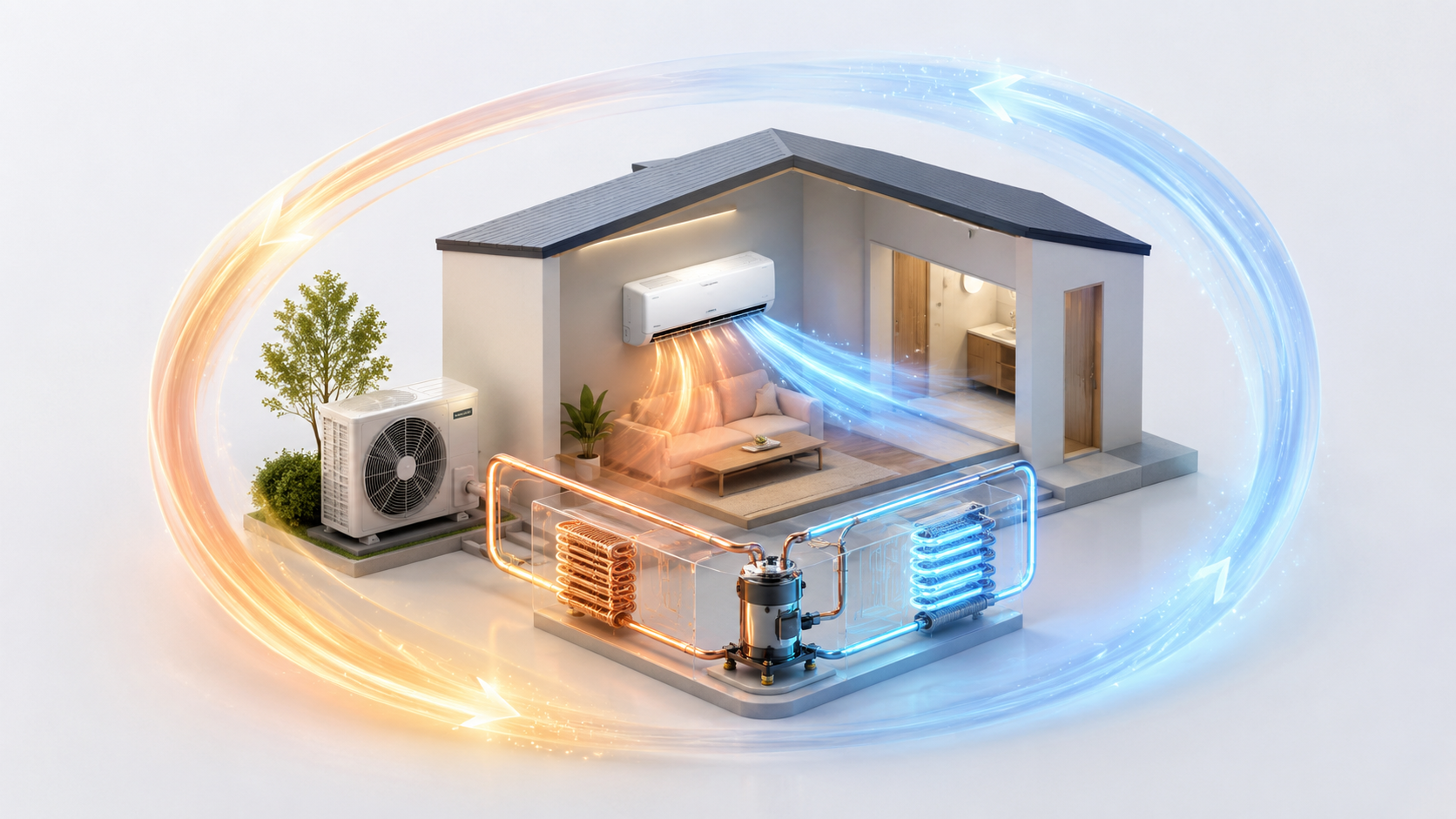
How Does a Heat Pump Work?
A heat pump works by moving heat from one place to another instead of creating heat directly. In winter, it transfers heat into the building. In summer, the process can reverse, removing heat from inside the building and releasing it outside.
This is why many heat pumps can provide both heating and cooling in one system.
Moving Heat Instead of Producing Heat
Traditional heating systems, such as furnaces or boilers, usually create heat by burning fuel or using electric resistance. A heat pump works differently. It uses electricity to transfer existing heat from air, ground, or water.
Even when the outdoor air feels cold, it can still contain heat energy. A heat pump collects that energy, increases its temperature, and delivers it indoors.
A simple way to understand this process is to compare it to a refrigerator. A refrigerator removes heat from inside the fridge and releases it into the kitchen. A heat pump uses a similar idea, but it is designed to heat or cool an entire room, home, or building.
Main Components of a Heat Pump
Most heat pumps use a few important parts:
Refrigerant A special fluid that absorbs and releases heat as it moves through the system.
Evaporator Coil The part that absorbs heat from air, ground, or water.
Compressor The part that increases the pressure and temperature of the refrigerant.
Condenser Coil The part that releases heat into the building during heating mode.
Expansion Device The part that lowers the refrigerant pressure so the cycle can start again.
Reversing Valve The part that allows many heat pumps to switch between heating and cooling.
Heating Mode
In heating mode, the heat pump collects heat from outside the building. This heat can come from outdoor air, the ground, or water, depending on the type of system.
The refrigerant absorbs the heat and carries it to the compressor. The compressor raises the temperature of the refrigerant, and then the indoor coil releases that heat into the building.
The heat can be distributed through ducts, wall-mounted indoor units, radiant floors, or water-based systems.
Cooling Mode
In cooling mode, the heat pump works in the opposite direction. It removes heat from inside the building and releases it outdoors.
This process is similar to how an air conditioner works. Because of this, many heat pumps can replace or reduce the need for separate heating and cooling systems.
Why Heat Pumps Are Efficient
Heat pumps can be very efficient because they move heat instead of generating all of it directly. They use electricity mainly to transfer heat, not to create it from scratch.
Their performance depends on several factors, including the type of heat pump, outdoor temperature, building insulation, system size, and installation quality.
Why This Matters for Sustainable Buildings
Heating and cooling are major parts of building energy use. By using energy more efficiently, heat pumps can help reduce energy demand and support more sustainable buildings.
They can also work well with other clean energy and efficiency solutions, such as solar panels, improved insulation, high-performance windows, and air sealing.
Final Thought
A heat pump may sound technical, but the main idea is simple: it moves heat to where it is needed. In winter, it brings heat indoors. In summer, it moves heat outdoors. This makes heat pumps an important technology for comfortable, efficient, and sustainable buildings.